
In March 2006, a four-year-old boy in Minneapolis died after swallowing a small heart-shaped charm that had come free with a pair of children’s shoes. The charm was nearly pure lead. It was part of a promotional bracelet given away with more than 300,000 pairs of shoes sold nationwide, and by the time anyone realized what had happened, there was no fast way to know which bracelets, from which production run, were affected.
That case — and a wave of toy recalls that followed in 2007, when tens of millions of Chinese-made toys were pulled from shelves for lead paint and small magnets — is a big part of why Congress passed the Consumer Product Safety Improvement Act (CPSIA) in 2008. Buried inside that law is a requirement that sounds almost bureaucratic next to the story behind it: every children’s product sold in the United States must carry a permanent tracking label. If you import, distribute, or sell children’s products, this single requirement is one of the most consequential — and most commonly overlooked — pieces of your compliance obligations.
This guide walks through what the tracking label rule actually requires, why it exists, and where importers and distributors most often get it wrong.
Why the Tracking Label Requirement Exists
It’s tempting to read the tracking label requirement as the CPSC doing importers a favor — a way to make recalls smaller and less disruptive. That’s a real side effect, but it’s not why the requirement exists. The core purpose is accountability: the CPSC needs to be able to trace a hazard, like lead, back to its actual source — the specific paint batch, pigment, resin, or component lot that introduced it — and then forward again into every other production run that used material from that same source.
A tracking label is what makes that chain traceable in both directions. If a batch of paint tests positive for lead, the CPSC and the responsible company need to know exactly which production runs used that paint — not just which product line in general. Without batch-level tracking, there’s no way to answer that question with any precision, which means there’s no way to hold a specific source accountable and no way to contain the problem at its origin rather than after the fact.
A narrower, faster recall is a downstream benefit of that traceability, not the reason it exists. Without it, the fallback is pulling an entire product line — often years’ worth of inventory — because there’s no way to isolate which batch actually contains the hazard.
The Legal Basis: Section 103(a) of the CPSIA
The requirement comes from Section 103(a) of the CPSIA, which amended the Consumer Product Safety Act. It took effect August 14, 2009, and it applies to all children’s products — generally, anything designed or intended primarily for children age 12 or younger, from toys and clothing to furniture, bikes, and juvenile products like cribs and strollers.
The CPSC later issued a formal Statement of Policy (2009) clarifying how it would interpret and enforce the rule, because the statute itself left some of the practical details — like exactly how small an item can be before the label moves to the packaging — open to interpretation. That guidance, plus the CPSC’s ongoing business-education FAQs, is what most of today’s compliance practice is built on.
What the Tracking Label Must Include
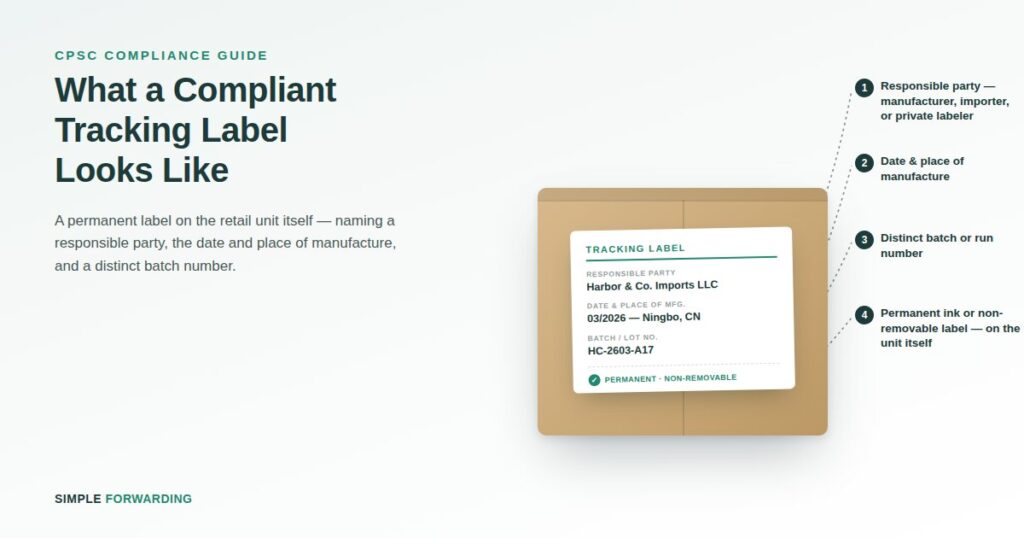
At minimum, a compliant tracking label needs to identify four things:
- A responsible party. This can be the manufacturer, the importer, or the private labeler/distributor — the rule doesn’t force you to name all three, just one identifiable party a consumer or the CPSC can trace the product back to.
- The date of manufacture. At minimum, the month and year of production.
- The place of manufacture. The location — factory, city, or region — where the item was made.
- A batch, run, or lot identifier, or another distinguishing production characteristic that lets you tell one production run apart from another.
The label can also include any other information that helps pinpoint the source of the product, and that information can be encoded (a code or a URL, for example) as long as the consumer has a way to find out what it means — typically by contacting the company listed on the label.
Every batch needs its own number — but not necessarily its own test
This is one of the more misunderstood parts of the rule. The tracking number has to be distinct for every production batch, full stop — that’s what makes the traceability work. But the testing behind the product doesn’t have to be repeated batch by batch. Under the CPSC’s third-party testing framework (16 CFR Part 1107), a product generally only needs to be retested when there’s a material change — a change to a component, material, supplier, or manufacturing process that could plausibly affect whether the product still complies with the applicable safety rules. A new colorway or a purely administrative change usually isn’t a material change; a new material supplier, a new plastic resin, or a changed manufacturing process usually is.
In practice: you can run five batches under one valid test report, as long as nothing material changed between them — but each of those five batches still needs its own unique tracking number on the label.
The Label Has to Be Permanent
A tracking label that can be peeled off, wiped away, or washed out defeats the purpose. The CPSC requires the label to be affixed using non-removable methods — permanent (non-removable) adhesive labels or indelible, non-fading ink or stamping, applied directly to the product where practicable. A sticker that falls off in shipping, or ink that fades after one wash, doesn’t meet the standard, even if it technically had all the right information on day one.
The Label Belongs on the Product Itself, Not Just the Master Carton
This trips up a lot of importers who are used to thinking about carton marking for customs and logistics purposes. The tracking label requirement is separate from — and in addition to — any marking on the shipping carton or master case.
The label has to be on the individual unit as sold on the shelf, because the whole point is that the end consumer, who has the product at home, can identify it and match it against a recall notice. A batch code on the outer carton doesn’t help a parent who’s already thrown away the box.
There’s a practical exception for products sold as part of a set or kit: if the item is sold to the consumer as a kit (say, a multi-piece toy set or an art supply kit), the tracking information can go on the kit’s consumer packaging rather than on every individual piece inside it. The same logic applies to products that are physically too small to carry a legible, permanent label — in those cases, the packaging carries the label instead, but the individual unit no longer being labeled is the exception, not the default.
Common Mistakes Importers and Distributors Make
- Assuming the overseas factory already handles it. Many overseas manufacturers are unfamiliar with U.S.-specific requirements like this one. As the importer, you’re the party the CPSC and CBP will hold responsible if the label is missing or wrong — “my supplier didn’t mention it” isn’t a defense.
- Confusing country-of-origin marking with the tracking label. Country-of-origin marking is also required to reach the consumer — on the product itself, or on the package as sold if marking the item isn’t practicable — so it isn’t purely a shipping-carton exercise. But it’s a separate requirement from the CPSC tracking label, with different required content. Being fully compliant on country-of-origin marking doesn’t mean the batch/production tracking information the CPSC requires is also there, and importers who manage one sometimes assume they’ve covered the other.
- Reusing one tracking number across multiple batches. If two production runs share a tracking number, you’ve defeated the entire purpose of the requirement, even if the product otherwise passed testing.
- Using labels or ink that don’t survive normal use. A label that survives a warehouse but not a wash cycle, a bath, or normal wear isn’t compliant.
- Not connecting the tracking number to internal records. The label only helps in a recall if you can quickly match a batch number back to your own production and test records — which means recordkeeping matters just as much as the label itself.
What Happens If You Don’t Comply
Tracking label violations are treated as a violation of the Consumer Product Safety Act. Depending on the circumstances, that can mean the CPSC requiring corrective action, a broader-than-necessary recall (because you can’t isolate the affected batch), and civil penalties.
The CPSC does have discretion to forgo formal enforcement in some cases — for example, a first-time, good-faith violation that’s corrected quickly — but that’s entirely up to the agency, not something a company can count on. It’s one of the reasons compliance counsel routinely recommend staying in open, proactive communication with the CPSC rather than staying quiet and hoping an issue goes unnoticed: a company that flags an issue itself is generally in a very different position than one the CPSC discovers on its own.
Beyond the direct legal exposure, missing tracking labels are also one of the more common reasons children’s product listings get flagged or removed by major marketplaces like Amazon during compliance reviews.
How the Lead-Poisoning Case Changed the Rules
It’s worth returning to where this started, because it explains why the CPSC is strict about this particular requirement even when it seems like a small thing.
In the mid-2000s, lead-contaminated children’s products became a national story. Reebok’s charm bracelet — given away free with children’s shoes between 2004 and 2006 — turned out to contain dangerously high levels of lead, and in March 2006 a four-year-old in Minneapolis died after swallowing a piece of one. Reebok eventually paid a $1 million civil penalty, at the time a record settlement for this kind of violation.
Then, in 2007, the problem turned out to be much bigger than one company. Millions of toys — including major brands’ products, manufactured overseas — were recalled for lead paint and hazardous small magnets in the same year. Congress responded with the CPSIA in 2008, one of the most sweeping consumer product safety laws in U.S. history, which tightened lead and phthalate limits, mandated third-party testing for children’s products, and created the tracking label requirement described in this guide.
The connective tissue between that tragedy and today’s compliance paperwork is traceability. Investigators and recall teams in 2006 struggled to determine exactly which bracelets, from which shipment, were affected — because nothing on the product identified its batch or origin, let alone the source of the lead itself. The tracking label requirement exists specifically to close that gap: to make sure that if it ever happens again, the hazard can be traced back to its source and every affected batch identified within hours, not weeks.
Compliance Checklist
- Does every children’s product unit carry a permanent tracking label affixed to the product itself (not just the shipping carton)?
- Does the label identify a responsible party (manufacturer, importer, or private labeler)?
- Does the label show the date and place of manufacture?
- Does the label show a distinct batch, run, or lot number for that specific production run?
- Is the label made with non-removable ink or a non-removable label material?
- If the product is sold as part of a kit or set, is the tracking information applied to the kit’s consumer packaging?
- If the product itself is too small to carry a label, is the tracking information on the packaging instead?
- Do your internal records let you match a tracking number back to the specific test report, supplier, and production run behind it?
- Has anything changed materially (materials, components, suppliers, manufacturing process) since your last valid third-party test report?
Frequently Asked Questions
It’s a federal requirement, under Section 103(a) of the CPSIA, that every children’s product sold in the U.S. carry a permanent, legible label identifying the manufacturer, importer, or private labeler, the date and place of production, and a batch or run number, so the product can be traced in the event of a recall.
Either one, in the sense that the label only needs to name one responsible party. But compliance responsibility as a legal matter falls on whoever brings the product into U.S. commerce — in practice, that means importers can’t assume their overseas manufacturer has handled it and are typically the party held accountable if it’s missing.
Yes. The tracking number must be distinct for each separate batch or production run, even if multiple batches were made from the same approved design and passed under the same valid test report.
No. Testing generally only needs to be repeated when there’s been a “material change” — a change to a component, material, supplier, or manufacturing process that could affect the product’s compliance with applicable safety rules. Batches produced without a material change can typically rely on the same valid test report, even though each batch still needs its own distinct tracking number.
No. It has to be on the individual unit as sold to the consumer, because the purpose of the label is to let the consumer — not just the warehouse — identify the product. Carton marking is a separate, additional requirement, not a substitute.
If the item itself is too small to carry a legible, permanent label, the required information can go on the packaging instead. Similarly, if the product is sold to the consumer as part of a kit or set, the tracking information can be applied to the kit’s packaging rather than to each individual component.
Non-removable adhesive labels or indelible, non-fading ink or stamping. A label or ink that can be peeled off, washed out, or worn away through normal use does not meet the requirement.
It’s a violation of the Consumer Product Safety Act. Consequences can include CPSC-mandated corrective action, a wider recall than would otherwise be necessary (because the affected batch can’t be isolated), civil penalties, and removal from marketplaces like Amazon during compliance review. The CPSC does have discretion to forgo formal enforcement in some cases, such as a first-time, good-faith violation, but that’s entirely up to the agency — which is why open, proactive communication with the CPSC is strongly encouraged rather than waiting to be discovered.
It traces back to a string of incidents in the mid-2000s — most notably the 2006 death of a four-year-old from a lead-contaminated charm bracelet given away with children’s shoes, and the massive 2007 lead-paint toy recalls — that exposed how hard it was to trace a hazard back to its source and isolate a dangerous batch without a tracking system. Congress created the requirement in the CPSIA to give the CPSC that traceability — from the hazard back to its source, and out again to every affected batch — not just to make recalls narrower after the fact.
Closing Thoughts
Tracking labels are a small line item on a packaging spec sheet, but they sit at the center of how the CPSC expects importers to manage risk. Getting them wrong doesn’t just risk a compliance letter — it’s the difference between a narrow, one-batch recall and having to pull an entire product line off the market.
If you’re importing children’s products and want a second set of eyes on your labeling, testing records, or overall CPSC compliance before your next shipment lands, Simple Forwarding works with importers every day to help make sure the paperwork matches the product before it ever reaches a U.S. port. Reach out to us if you’d like a compliance gap-check on your current suppliers and labels.
Want the pros to handle it?
We do this daily (the registration, the citation research, the test report review, all of it). Reach out and our team takes it from A to Z, so you don’t have to.
Sources
- CPSC — Tracking Label Business Guidance
- CPSC — Tracking Label FAQ
- CPSC — Reebok Recalls Bracelet Linked to Child’s Lead Poisoning Death (2006)
- Consumer Reports — Reebok to Pay $1 Million Fine in Lead Charm Settlement
- Federal Register — Statement of Policy: Interpretation and Enforcement of Section 103(a) of the CPSIA
- Duane Morris LLP — Tracking Labels Must Be Placed on Children’s Products by August 14, 2009
- CPSC — Third Party Testing Guidance
- CPSC — Material Change Testing FAQ
- CPSC — 16 CFR Part 1107, Testing and Labeling Pertaining to Product Certification
- ComplianceGate — CPSIA Tracking Label Guide for Importers & Amazon Sellers